
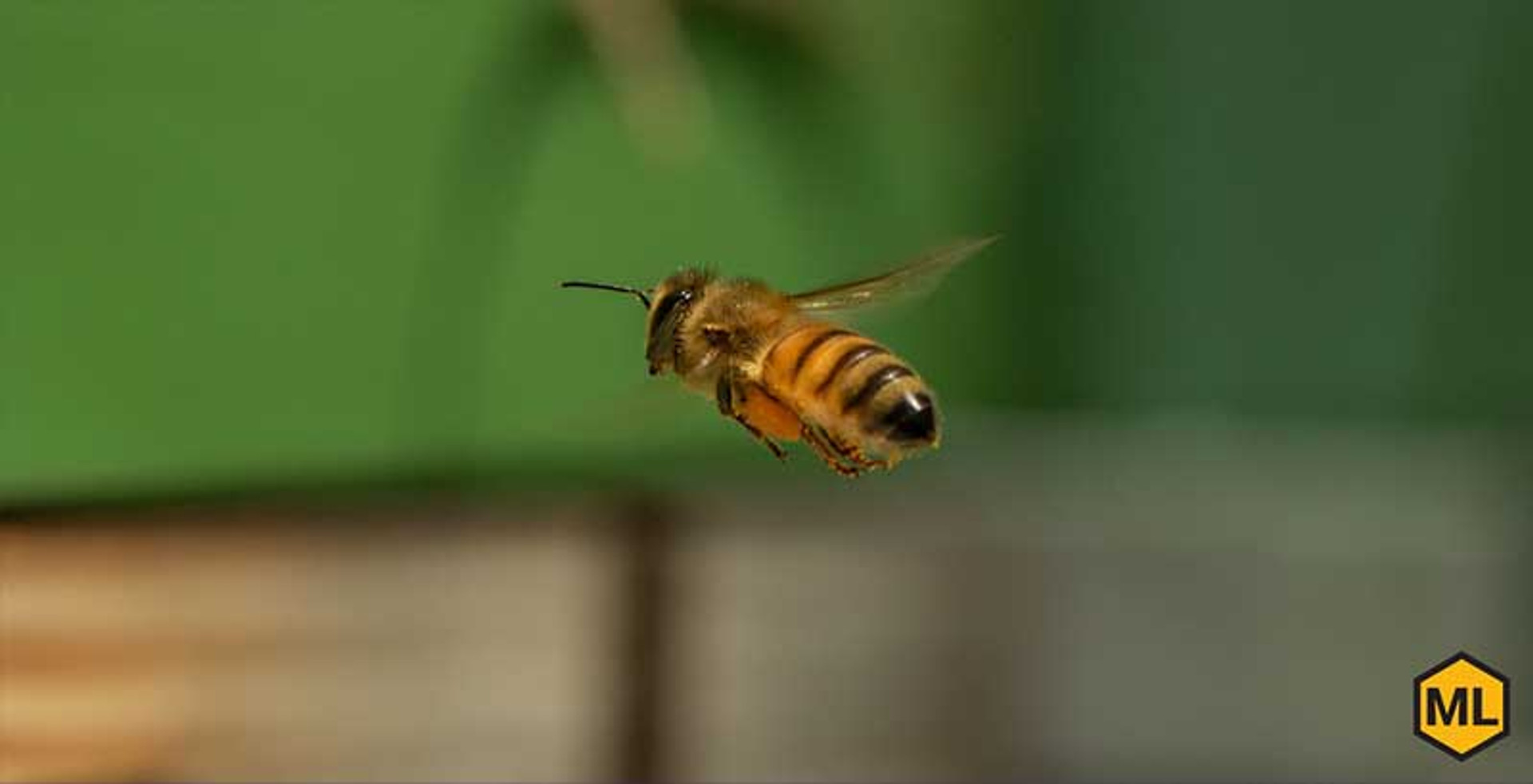
How Do Bees Fly? The Science Behind Their Tiny Wings
TL;DR:
Scientists once thought bee flight was impossible, but research shows honey bees use rapid wingbeats, unique wing mechanics, and powerful thorax muscles to achieve flight. Their method may be less efficient than other insects, but it’s perfectly suited to their role as pollinators.
- Honey bee flight was long misunderstood, leading to the myth that bees shouldn’t be able to fly.
- Bees generate lift through twisting wing motions and over 230 wingbeats per second.
- Their forewings and hind wings lock together with hamuli, acting as one large surface.
- Unlike many insects, bees use short, rapid arcs (about 90°) instead of wide sweeps.
- Honey bees fly 15–20 mph unladen and around 12 mph when carrying nectar or pollen.
For many years, scientists—along with many other curious individuals—wondered how bees fly. Their round, fuzzy bodies and tiny wings seemed too small to support flight. In fact, even scientists once believed it was technically impossible for bees to fly!
Unlike other creatures that take to the air, honey bees don’t seem like they should be able to buzz around the way they do. Yet they do, and years of research and observation have taught us how. If you’re buzzing with curiosity about this accomplishment, check out our guide to understanding honey bee flight.
Busting the Myth: Is It Really Impossible for Bees to Fly?
For decades, a myth circulated that aerodynamics proved bees shouldn’t technically be able to fly. This misconception came from applying airplane-wing physics to bee wings. However, airplane wings are very different in both structure and function compared to an insect’s wings.
Honey bee flight is not impossible, however. It’s simply different than how most people expect it to work.
Today, scientists know that bees generate lift through rapid wingbeats combined with a twisting, rotational motion. When we look critically at how honey bees fly, the physics ultimately makes sense. Let’s take a closer look at the honey bee anatomy that makes this phenomenon possible!

The Anatomy of a Honey Bee
The first step in understanding how bees can fly with small wings is to learn about their anatomy.
Honey bees have two wings on each side of their body: the forewing and the hind wing. A comb-like ridge called the hamuli holds the forewing and the hind wing together. This allows them to act as one large surface when the honey bee flies.
To achieve flight, the honey bee’s tiny wings twist and rotate along its body, making a sweeping motion as it flies. This flexible movement generates more lift, allowing the honey bee to carry its relatively heavy body through the air. Don’t forget that honey bees often carry heavy loads of pollen, too.
Meanwhile, muscles in the thorax squeeze in two different directions: up and down, and left to right. The honey bee alternates flexing these muscles to create a rhythmic, pulsating pattern through the thorax. These pulsations cause the wings to beat rapidly. In fact, they beat over 230 times per second, which powers their unique flight style!
How Honey Bee Flight Differs From Other Insects
Compared to the flight of other flying insects, honey bee flight is inefficient. Generally speaking, larger creatures have slower wingbeats. Compare, for example, the slower wings of an eagle to the rapid pace of a hummingbird’s wings.
Honey bees are relatively large insects, but they beat their wings much more quickly than fruit flies and other smaller bugs do. Furthermore, many flying insects move their wings in wide arcs, sometimes up to half-circles. Honey bees make sweeping motions with their wings, but the wings only cover an arc of about 90 degrees.
Why are honey bees different?
Some scientists believe their peculiar wings and flight muscles are evolutionary ticks that modern honey bees must live with. Others believe that the honey bees’ flight style allows them to carry heavier loads, such as full pollen baskets. This unique style of honey bee flight highlights how evolution has fine-tuned bees to balance efficiency with strength. It’s how they’ve endured as one of nature’s most effective pollinators.
How Fast Do Bees Fly?
How fast does a bee fly when buzzing from flower to flower? On average, a honey bee flies at about 15 to 20 miles per hour when unladen. When carrying nectar or pollen back to the hive, their speed drops to around 12 mph.
This combination of wingbeat frequency and short wing arcs allows bees to cover large distances despite their small size.

Experience the Magic of Honey Bee Flight
The more you learn about honey bees, the more fascinating they become. Are you eager to delve into the world of these curious little pollinators?
Nature’s tiny fliers are full of surprises. Ready to see the magic up close? Start your beekeeping journey with our beginner beekeeping essentials.